Key Takeaways
- Skills intelligence redeployed 20% of workforce, saving $1M in HR costs.
- Tip: Start small—pilot projects drive momentum in skills transformation.
- Align stakeholders early: normalize skills and partner across functions for impact.
Becoming a skills-based organization can feel like “jumping into the deep end,” but that jump will be much easier for skills transformation leaders who can make a strong business case for the change, according to Forrester Principal Analyst, Future of Work, Betsy Summers.
“No one's going to give you a gold star for being a skills-based organization,” Forrester says in a Cornerstone (formerly known as Skyhive) webinar that took place on June 27th. “All the people care about is, are we actually able to achieve our objectives and our goals?”
In the webinar “Making a Business Case for Skills,” available to watch here, with Summers and Gregory Varshavskiy, Head of Product Marketing at a company formerly known as Skyhive (now a part of Cornerstone), Summers offers strategies and tips based on her research on successful skills transformation efforts.
“When we do our surveys at Forrester, skills come up as the number one or number two reasons for some kind of blocker or barrier to the business,” says Summers, who covers the future of work for Forrester Research. “Business leaders are questioning ‘How do I resolve that?’”
For example, in one case a medical manufacturing company was faced with a business challenge of shifting away from brick-and-mortar stores to other channels. By adroit use of skills intelligence for internal mobility, the company was able to redeploy 20% of their workforce, compared to only 11% historically, which saved them $1 million in severance and recruiting costs.
“Their CFO said this is one of the most lucrative and creative investments in HR ever made,” Summers says. Cases like that provide the starting point for the five tips Summers offers for using skills intelligence effectively.
Five Tips for Using Skills Intelligence Effectively
First, identify the compelling business problem or problems to be solved. Summers says skills intelligence is a tool to solve business problems, but organizations need to be clear on what the problems are.. “Really identifying that business problem you're trying to solve will help direct what metrics, what KPIs you're measuring, how you are actually tracking progress,” Summers says.
But the process is important, with most organizations using manual methods of managing skills that aren’t “fit for purpose.” she says. Information sources are siloed, and different terms are being used for the same skill or role. Many companies have “prep work” they have to do around skills normalization–making sure everyone is using the same definitions–before they can be effective in skills transformation (the ability to create a skills-first job architecture is built into the Cornerstone HR and Workforce Intelligence platform).
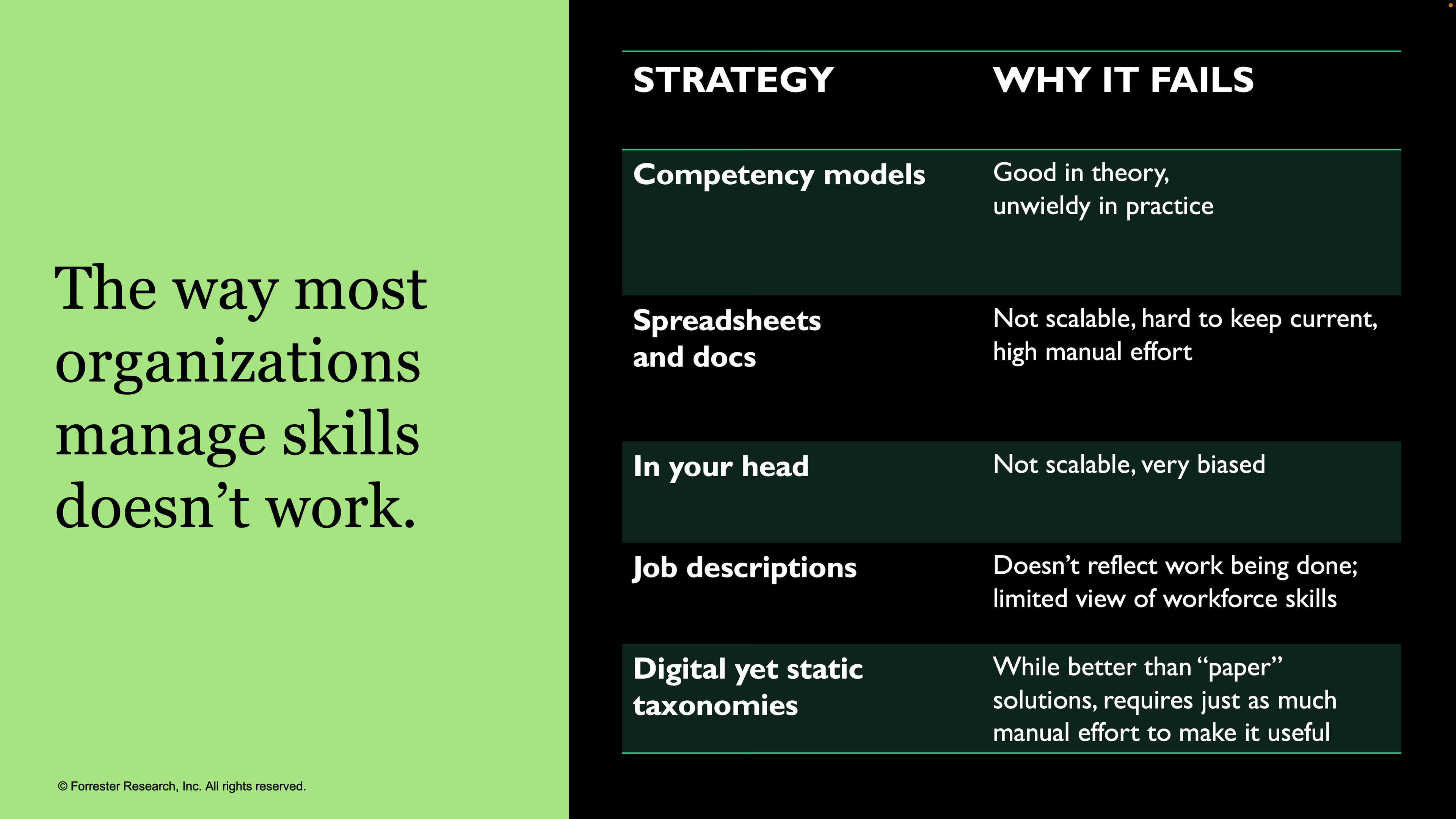
Second, gather trusted partners internally and externally to anticipate and overcome problems. Value isn’t something that comes solely from technology, Summer explains. There are multiple stakeholders around the organization who need to think about talent management in new ways to ensure the company really gets value out of the changes.
Third, partner in lock-step with key functional leaders. “(Skills transformation leaders) don't want people to feel like this is something that HR is thrusting upon people,” Summers states. “And so it's important to make sure that you are always talking to business leaders about what they need, what skills they think are critical, making sure that what you are building or bringing into the organization will work for them and their workforce.”
Fourth, start small to go big with incremental steps. A pilot-project approach allows organizations to try out strategies and build support among stakeholders, says Summers.
Starting small and going big over time is also a key principle in our framework for skills transformation. Cornerstone Transform uses a four-stage process designed to provide a road map to using Cornerstone technology and implementing skills-based HR strategies. This approach prepares companies to answer key questions, including identifying the difference between the skills employees already have and the skills they will need; and what actions can be taken to fill the gaps.
Fifth, wield change leadership to drive momentum and confidence. Employees will be asked to put in the effort to build skills profiles and do things differently, so they need to see a payoff for their effort. “What we want to make sure of, especially for the workforce, is that [employees] see the value as well,” Summers says.
Work with Cornerstone Transform
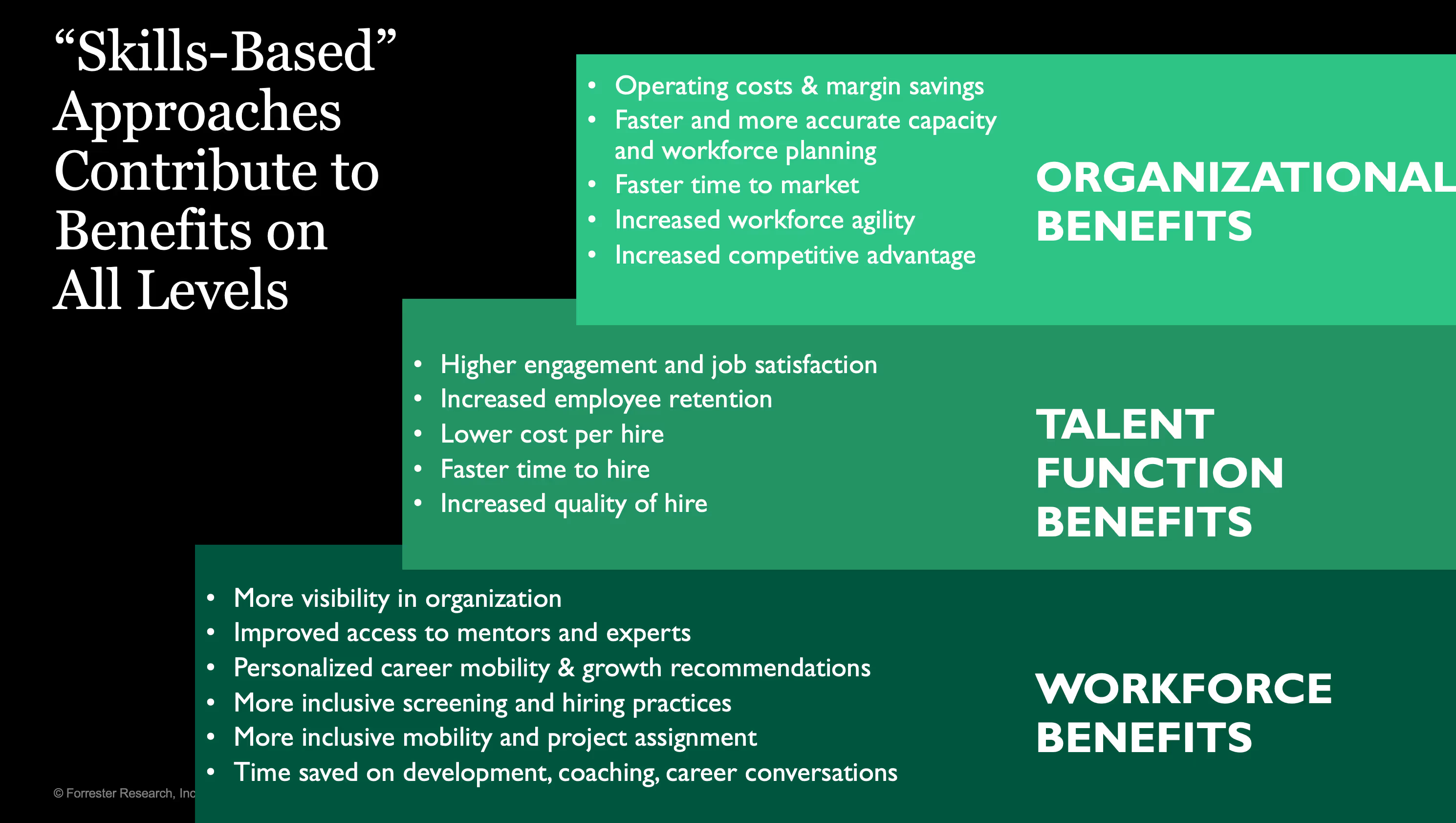
Your new modern skills-based job architecture provides the foundation to improve talent acquisition, talent management, employee training, career development, employee retention, and the employee experience.
Powered by responsible and ethical AI, the Cornerstone Transform skills engine integrates with your organization’s human capital management (HCM), talent management software, workforce management, career development plans, employee training and development, and other systems.
ROI for validation to executive stakeholders includes lower attrition rates, higher internal mobility and much more. AI skills intelligence becomes a foundational data layer to power your employee engagement strategies, employee retention strategies, and the career development goals of your global workforce.
For more from this webinar with guest speaker Betsy Summers from Forrester Research, view the webinar recording here.