Key takeaways
- India leads Asia Pacific on AI adoption but not on readiness, with “AI blind spot” its largest capability gap. Leaders rate AI and workforce readiness 24 points higher than their own people do, the single widest leader-employee split in our research.
- Adoption does not mean readiness. High confidence can mask the problem, because leaders who assume their people are ready stop investing in getting them there.
- The value at stake is around ₹7 million per 1,000 employees a year, recovered through lower attrition, reduced absenteeism, and more efficient hiring. Culture, engagement, and trust provide the highest returns.
- Workforce intelligence makes readiness visible and actionable. It connects skills, learning, and performance into insights that leaders and their people can use in the flow of work.
Across the markets I work with in Asia Pacific, India didn’t wait for AI to arrive. Close to nine in 10 Indian organizations already use AI in some form, according to the National Association of Software and Service Companies (NASSCOM). More than 90% of the workforce has picked up a generative AI (GenAI) tool, and India now accounts for roughly one in six of the world’s AI professionals. Layer on the “India Stack,” the country's digital public infrastructure, and you have a market with the scale, youth, and appetite to lead.
Our own research says the same about the people. In our Culture and Capability Index (CCI) for Asia Pacific, 74% of Indian employees told us they felt equipped to adapt to AI and automation, the highest confidence of any market in the region.
India’s path to becoming an AI powerhouse, however, will depend on whether that confidence holds all the way down.
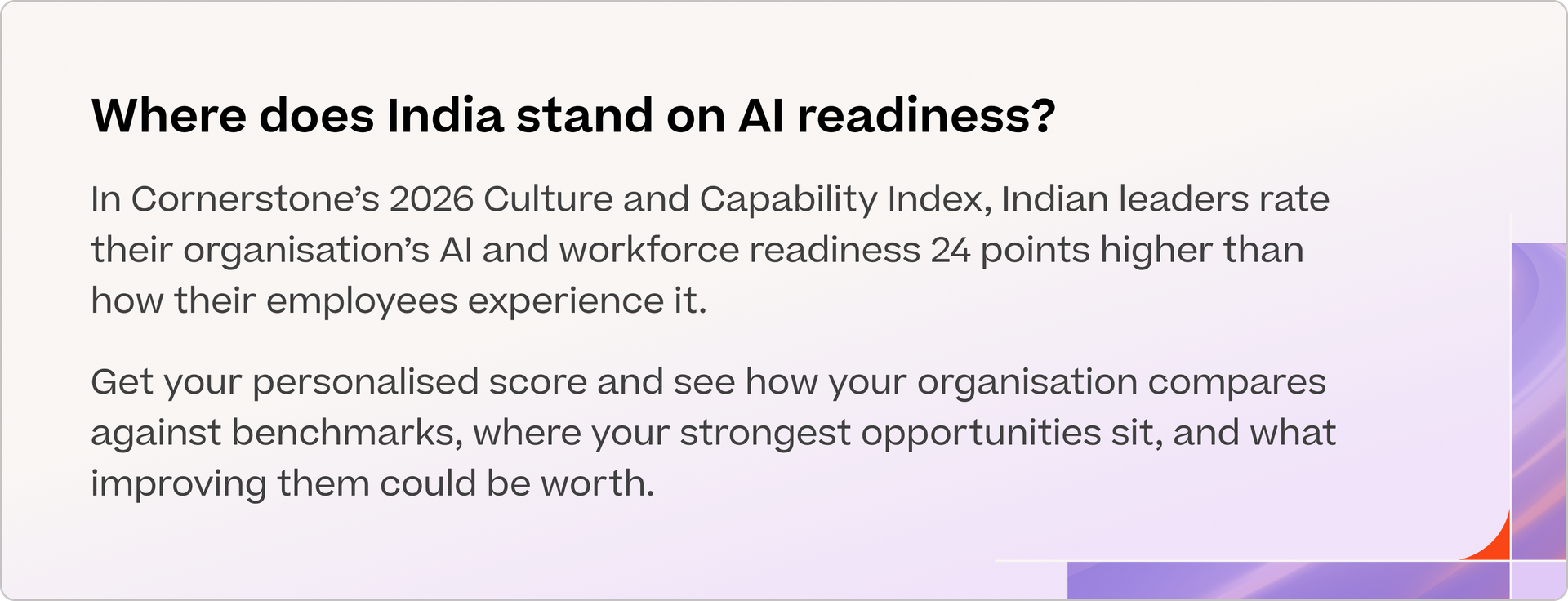
In the same CCI findings, HR leaders in India rated their organization’s capability 88 out of 100, in the band we call “Leading”. When we asked their own people the same question, the score fell to 72, two full bands lower, which is “Emerging”. The widest gap of all is not in some ageing back-office system. It is in AI itself, a 24-point gulf between what leaders believe and what their people experience. It’s what we call the “AI blind spot,” the capability everyone is most confident about yet the one that their people feel least ready for. When leaders run ahead in their heads while their people are still finding their feet, the result is a trust deficit.
AI adoption does not mean readiness, and confidence can hide the difference
It helps to be precise about what adoption, readiness, and confidence mean, because they get used interchangeably.
Adoption is activity, which is countable and feels like progress. It’s the tools rolled out, the licences bought, or the fluency targets hit by the end of the quarter. Readiness is whether your people can keep adapting as the work itself changes continuously underneath them. It can be harder to measure, because it doesn’t directly register on a dashboard. You see it when your people can still do their jobs 12 months from now, even if the skills they require have changed.
This is where confidence can turn from an asset into a risk. When leaders are sure their people are ready, they stop topping up. After all, why keep investing in something you’ve seemingly won? The gap quietly widens, hidden by the confidence that should have been bridging it.
In fact, seven in 10 Indian professionals told an HRTech survey they expect their role to change significantly within two to three years. In the same breath, only a quarter of Indian organizations believed their workforce was prepared to use AI effectively, a figure that had fallen 12 points in a year. Adoption is climbing, but readiness, by people’s own account, is going the other way. When the employees closest to the work feel less prepared despite the tools being everywhere, the problem might not be the pace of adoption.
Why workforce and AI readiness is also a business challenge
The technology is already far ahead of our ability to use it. So if your people aren’t ready, what’s holding them back might not be the tech, but the experience around it: how you define the work, how honestly you talk about what’s changing, and whether you keep a human at the centre of it.
You can see this in failed AI projects. MIT reported that roughly 95% of GenAI pilots delivered no measurable return, while PwC found that while 95% of Indian organizations have started adopting agentic AI, only 14% have moved past early testing.
Those are sobering numbers, and it would be easy to read them as a verdict on the technology. They are not. In almost every case, the underlying problem pointed to unclear business value, weak governance, no ownership of the outcomes, and workforce readiness.
Consider internal mobility. In our CCI findings, leaders and their people across Asia Pacific mostly agree on whether there are paths to move, grow, and build a future inside the organization. The regional gap between the two views is less than two points. For a measure this subjective, that is close to consensus.
In India, the gap runs to almost 20 points. Leaders are confident their organizations offer strong internal mobility and clear career paths. Their people, in large numbers, do not experience it that way. This is the widest leader-to-employee disconnect on career growth anywhere in the region, and it is hiding underneath some of the most confident leadership scores we measured.
On its own, a perception gap might be survivable. It might not be the case for India because of who the workforce is. This is one of the youngest workforces in the world, and young people do not wait quietly for a path to appear. In fact, our research shows that roughly seven in 10 Gen Z employees would leave for somewhere with better development opportunities. Put those two findings side by side and a perception gap turns into a retention cost. The people you’d want to keep are the ones with the least patience for a career that feels stuck.
Upskilling is another challenge. When AI absorbs the routine parts of a role, the key is to elevate people up the value chain, into work that needs judgement, relationships, and invention. However, you cannot move them up if there is nowhere visible for them to go.
Embedding workforce intelligence in the flow of work, with trust as the lever
The common thread in all of this is visibility. Leaders and their people could be seeing different pictures of the same organization, so no one can act on what they cannot see.
Workforce intelligence gives a shared, fuller picture by connecting the scattered systems an organization already runs. There’s the system of record, the tidy database of names, titles, and tenure that tells you who someone is on paper. There’s the system of work where the job gets done, then there’s the system of experience, where you see how people reach information in the first place. Most organizations have all three, but almost none of them talk to each other. The point of joining them is to put the right solutions in front of the right person at the right moment they need it.
In India, our research points to where leaders should start. Close to a third of the total recoverable economic value in the Indian market comes from culture, engagement, and trust. The same trust deficit that sits underneath all that confidence turns out to be its biggest return.
Your people also watch what you do far more closely than what you announce. For instance, BCG found that when people feel genuine support from their leaders on AI, the share who feels positive about it jumps from around 15% to 55%.
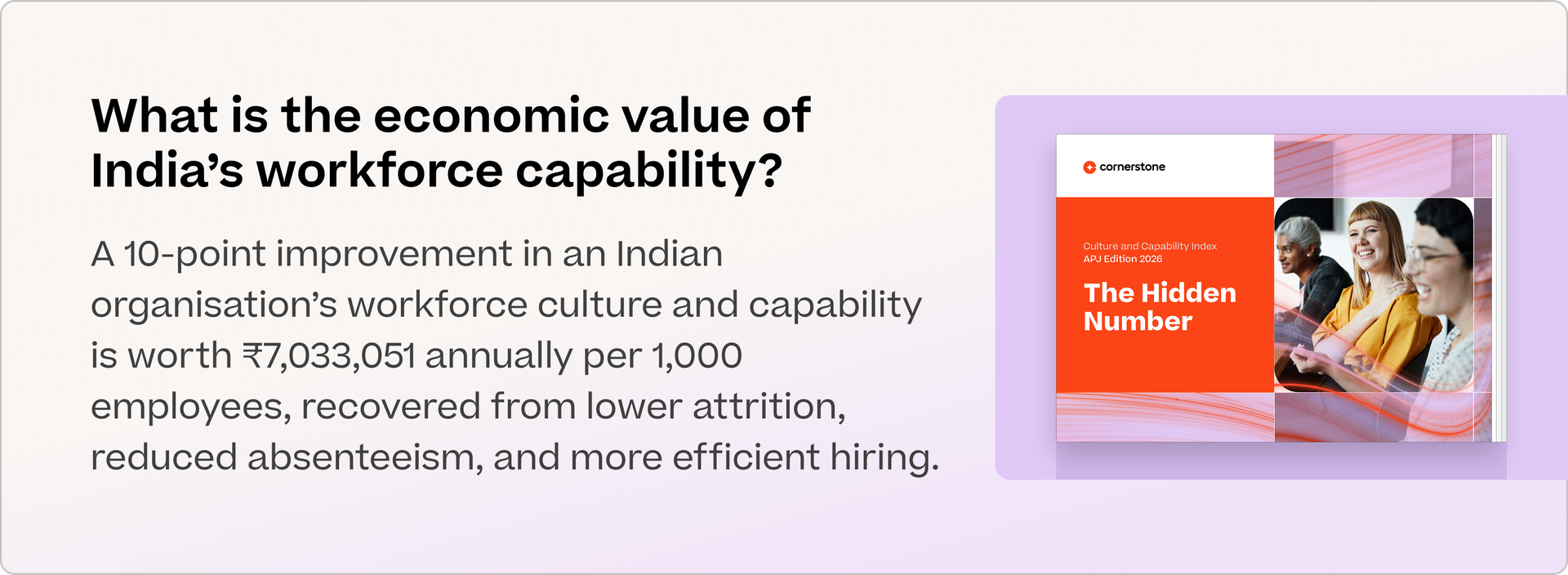
Culture, engagement, and trust are not soft gestures. Moving the workforce from where leaders think it is to where it needs to be is worth in the order of ₹7 million per 1,000 employees every year, based on our CCI findings. It is business value already leaking out of the organization through avoidable attrition, lost productivity, and inefficient hiring.
What CHROs and CIOs should own to improve AI and workforce readiness
Readiness fails when it belongs to everyone and no one. It comes down to decisions about ownership, honesty, architecture, and how the organization chooses to work.
AI readiness begins at the top. AI fluency should be a continuous, personalized program, which needs an owner with the authority to fund it and the patience to keep supporting it even after the launch buzz has faded.
For the CHRO, the job is fostering trust. This is harder than it sounds, because it asks for honesty most organizations flinch from. It is not easy to tell a recruiter you want them to get good at AI, knowing that that same AI is coming for a large part of what they do today. If that is the reality, be prepared to make the braver conversations about how their work is changing and how they’ll be empowered to move up rather than get left behind.
For the CIO and CTO, an ostensibly counterintuitive advice is to stop worrying about the technology. What’s needed is clarity on what signals you are feeding in, where the trusted record of information about your people lives, and what outcomes you are chasing. Get the governance and the trust model right, expose the right pieces, and the technology will do its part.
Indeed, AI leadership won’t be settled by compute, by capital, or by who trains the largest model. Those are important, but India’s advantage is its people. The technology can be the easier part to acquire, but readiness is the harder part to develop and the only part your competitors can’t simply obtain to match you.
For any organization serious about AI, the competitive advantage is not in what you adopt or how much you spend, but which way you turn at the pivot. India is standing there now, and which way it turns will be decided by whether people are ready for it.