Key takeaways
- Treat an LMS implementation as a business initiative: HR leads the vision, IT enables it. Together HR and IT build alignment across the organization around business outcomes, not features.
- Strong governance and user experience are non-negotiables: A clear governance plan and building a user experience that makes learners want to learn and grow are important factors in a successful LMS implementation.
- Structured change management is crucial: From early communication to role-specific training, structure change management is what makes the difference between a system people use and one they work around.
You made the business case for a new learning management system (LMS); got the buy-in and budget approval. Signed on the dotted line, and you’re ready to transform training, onboarding, and upskilling across your organization. But now it’s time to implement your new LMS, and you’re not sure where to start.
The planning, politics, change management – the moment you realize half your content library is outdated – it’s a lot, and the stakes are high. Organizations invest time, budget, and energy into an LMS rollout, but if it’s handled poorly, they can end up with a platform that’s technically live but never fully adopted.
There’s a better way. With a strong strategy, process, and governance, your LMS implementation will go smoothly and quietly putting in place the infrastructure that enables real people development, and the returns are measurable. McKinsey & Company found that companies excelling in people development achieve more consistent profits, demonstrate higher resilience, and retain talent at significantly higher rates, with attrition running about five percentage points lower than organizations focused primarily on financial performance.
Drawing on real customer stories and best practices learned across more than 7,000 deployments, our seven-step blueprint for a seamless LMS implementation will help you go live faster, avoid common missteps, and get to value sooner.
Define what success looks like
LMS implementation mistakes are rarely technical; they’re strategic.
Organizations try to launch their whole LMS wish list – compliance training, onboarding, leadership development, external partner programs — all at once, all on day one. The rollout is spread too thin, timelines get pushed out, and excitement quickly gets replaced by frustration.
Sandeep Reddy, founder and CEO of Reddsand — an HR and management consulting firm that specializes in enterprise Cornerstone implementations — put it plainly, “It's the quick wins that are important. Don't try to do everything at once, or you'll make it too complicated, and then it might not even solve your business problems. Aim for quick outcomes and build upon their successes."
First, get clear on business priorities. What does a successful first 90 days look like? Consider which business problem is most urgent: closing a compliance gap, accelerating time-to-productivity for new hires, or consolidating fragmented training content onto a single platform?
Pick the two or three business outcomes that matter most right now, define how you'll measure them, and build your implementation plan around those priorities. This clarity gives your project team a north star when decisions get hard.
"Understand what business problem you are trying to solve, and consistently make sure that at every stage of the program or project, you are benchmarking against that business problem,” Reddy explained.
Establish a robust governance framework
A strong governance framework is often the single most important factor in a successful implementation. It helps you avoid "failure by democracy," where too many stakeholders pull in different directions and slow everything down.
Before migration begins, define every permission and structural element of the new system. This may seem like overkill, but it enforces consistency and clarity across your organization, especially if you operate across multiple regions, business units, or regulatory environments.
Your governance plan should define:
- Roles and responsibilities: Who is responsible for what?
- System administration: Who has the authority to make changes to the system?
- Content management: Who can create, approve, and publish content?
- Reporting and analytics: Who has access to what data?
The payoff for doing this work upfront is spending a lot less time putting out fires later.
LKQ's governance-first approach enables four-month global migration
Luis Alicea, global e-learning strategy manager for LKQ Corporation, took a governance-first approach to migrating its 48,000 employees across 20 countries to Cornerstone in just four months. The LKQ team mapped over 130 detailed requirements across user, admin, job, organizational, and reporting needs before configuration even began and built a rigorous governance plan.
“Having that disciplined approach and being harmonized made the transition seamless, because everyone knew where everyone else stood at all steps of the project,” said Alicea.
Assemble a cross-functional project team
The decisions made during your LMS implementation will impact every corner of your organization and must reflect the needs of all your users.
HR won’t know what the sales team needs in a learning path without asking. IT can’t anticipate compliance requirements, and finance will keep questioning the budget if they don’t see what it’s driving for the business.
Without the right voices in the room from the start, you end up making choices that work for one team, create problems for others, and lose adoption along the way.
Build a cross-functional team that includes:
- HR and learning and development (L&D): Leads the project and aligns to the overall talent strategy.
- Information technology (IT): Manages the technical aspects of the implementation, including data migration, security, and integrations.
- Business units: Ensures the LMS meets the specific needs of different departments and user groups.
- Finance: Tracks the project budget and measures return on investment (ROI).
- Communications and marketing: Develops and executes the change management and communication plan.
Cornerstone’s Director of Talent Management & Development, Ilenia Diaz, says “there are two critical groups to include in your cross-functional team: end users, the people who will actually use the LMS day-to-day, and change agent or ambassadors, those who tend to be, respected peers from within business units. Both groups should be involved during the planning stage, not at rollout.” Diaz describes both group’s involvement:
- End users: Should be involved early, not just consulted at testing or launch. Early involvement reveals real workflow needs, builds a sense of ownership, and significantly improves adoption. Without it, you risk building something technically correct that nobody wants to use.
- Change agents or ambassadors: Are equally important upfront. They act as the bridge between the project team and the wider workforce. They call out concerns early, translating the "why" in language that resonates with their teams, and creating grassroots momentum before go-live. Appointing them late reduces them to messengers rather than genuine advocates.
Develop a detailed project plan
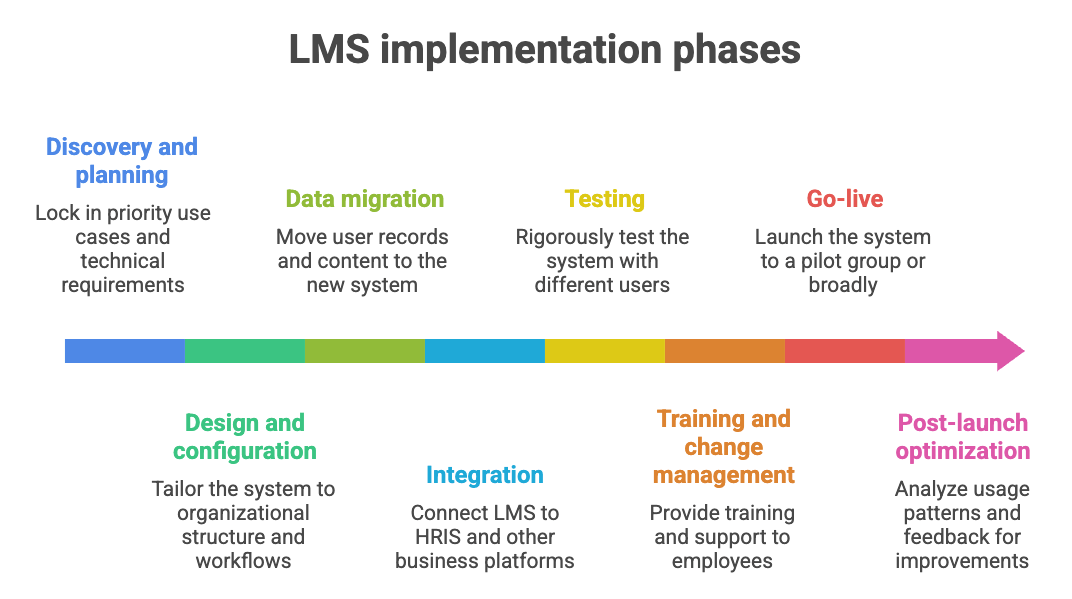
Your project plan breaks down the LMS implementation into manageable phases, with clear ownership, deliverables, dependencies, and timelines – plus a realistic buffer in between to account for unexpected hiccups.
A typical LMS implementation moves through these phases:
- Discovery and planning: Lock in priority use cases and quick wins, technical requirements, and stakeholder buy-in. Don’t rush this phase – you’ll end up reconfiguring the system later to accommodate new requirements as they surface.
- Design and configuration: Tailor the system to your organization's structure, roles, workflows, and governance rules. Look for opportunities to use artificial intelligence (AI) to automate tedious, manual processes. By designing the LMS to fit how your team works best, you’ll increase employee adoption and improve productivity.
- Data migration: User records, training history, certifications, and content all need to move cleanly from your old system to the new one. Take this opportunity to retire outdated content, so you only move over valuable resources for your teams.
- Integration: Connecting your LMS to your human resource information system (HRIS) and other business platforms ensures employee data, roles, and permissions stay current, without needing to be manually updated every time someone is hired, changes roles, or resigns.
- Testing: Before releasing the system to employees, vigorously test it by walking through tasks as different users, not just an admin. Ideally, bring in multiple users and note where they get confused or frustrated, not just whether functionality works as intended.
- Training and change management: Training should cover how the platform fits into people's actual day-to-day work, what they're expected to do, and where to go when they're stuck. Role-specific training is especially helpful to show real-world benefits.
- Go-live: If your timeline allows, launch to a pilot group before rolling out broadly. Launching to one department or region tells you which features and training materials people are most excited about, where they get confused, and common questions to answer.
- Post-launch optimization: Post-launch is when the real learning begins. Look closely at usage patterns, drop-off points, and feedback that emerges in the first 90 days (and routinely after) to prioritize enhancements and give employees support.
Thoroughness at all phases pays off in a smoother implementation and better employee experience.
Plan and execute a meticulous data migration
Data migration can be one of the most challenging aspects of an LMS implementation, and mistakes here tend to surface at the worst possible moment, like during an audit or when an automated workflow breaks down.
Build a detailed plan for migrating user data, training records, and content from your old system to the new one. Map data fields across systems, cleanse and normalize existing data, and confirm everything transferred accurately.
Similarly, be ruthless about auditing your content before you move it. You only want to bring over current, relevant resources; not inherit years of clutter from every outdated course, superseded brand update, and retired program.
Takeda achieves 98% compliance completion with centralized LMS
Takeda, a global pharmaceutical company with over 50,000 employees, knew their training content needed a clean start. Before consolidating onto Cornerstone, they were running three separate LMS systems with no central learning experience platform.
"Our learners were confused on where to go for training," recalled David Barone, Takeda's learning leader. "Even as a learning professional, I had to rely on sticky notes to remember where specific trainings were located."
By consolidating content into a single platform and establishing clear standards for what could live there, Takeda achieved 98% compliance completion and a sixfold increase in non-mandatory learning hours in the years that followed.
Invest in proactive change management
How employees experience an LMS rollout can impact user adoption. A proactive change management strategy positions the platform as a tool that serves employees first, connecting their day-to-day learning to meaningful development and clear business outcomes.
Your change management plan should include:
- A clear communication plan: Be explicit about what’s changing, why it matters, what employees need to do differently, and how the new system supports business outcomes and professional growth.
- Stakeholder engagement: Involve key stakeholders early so the system reflects real workflows and is tested by real users. This also helps surface edge cases and gaps, before they become bigger issues post-launch.
- User training: Provide role-specific training and ongoing support — not just a one-time session before go-live. The more closely training mirrors how people actually use the system day-to-day, the faster adoption will follow.
- A network of champions: Identify early adopters who can support their teams and reinforce adoption. They become the go-to people when questions come up and help others get comfortable using the system.
- A phased rollout: Start with a smaller group or high-priority use case, then expand. This gives you room to test, learn, and fix issues before rolling it out more broadly.
Alaska Airlines achieves full LMS adoption across 23,000 employees
Alaska Airlines phased its rollout of Cornerstone across its nearly 23,000 employees, each with very different training needs and schedules.
“The very first group to go on Cornerstone was our flight attendants, followed by our pilots,“ explained Val Dotson, senior LMS administrator at Alaska Airlines. “Then after that, about a year later, our airport ops group came on, as well as the smaller groups like legal, compliance and safety. As of a couple of years ago, everybody that was targeted to be on Cornerstone was on Cornerstone."
That deliberate, patient deployment of prioritizing the groups with the most critical or complex training needs first, then expanding, meant each rollout phase could be refined before the next began.
Measure, iterate, and optimize
Just because the hard work of going live is complete, doesn't mean you take your foot off the gas.
You need to continuously gather feedback from users, analyze activity, and iterate on your approach to get the most out of your LMS investment.
Treat measurement as an ongoing discipline, not a task to check off your list. Mercer’s 2026 Global Talent Trends report found that 57% of the C-suite see improving people analytics capabilities as the people initiative that will drive the most ROI.
LKQ is an example of what this looks like at scale. They consolidated hundreds of legacy reports into a handful of core Power BI dashboards, enabling true global scorecards across L&D, sustainability, development, training hours, and compliance.
What a successful LMS implementation achieves
A smooth implementation means new hires ramp up faster, managers effectively upskill their teams, and promotions, certifications, productivity, and retention increase across the organization. Outside of just business metric, a well-implemented LMS should also change or improve how employees experience learning at work. New hires should feel supported from day one and managers should have the tools to develop their teams with intention. And people across the organization can see a clear connection between their learning and their growth.
You’ll know your LMS rollout went well when:
- People continue to use theLMS: A well-implemented platform with intuitive navigation, personalized learning paths, relevant resources, and built around how people actually work, learning becomes a part of the workday and not just a one-off task. Because learners have easy access to personalized training resources sustained adoption is more achievable.
- L&D becomes a genuine partner to the business: When your platform generates clean, reliable data on completions, skill gaps, compliance status, and learning trends, L&D gets the data needed to influence decisions and take strategic action.
- Compliance is no longer a burden and becomes manageable. Automated assignments, certification tracking, and audit-ready reporting remove the manual work from both the admin side and employees, eliminating the need to keep track of which training requirements need to be fulfilled and when. This frees up time for L&D professionals to focus on building better learning programs, and for employees to learn and develop new skills at their own pace.
- Onboarding new hires becomes faster and more consistent. Role-based learning paths mean new hires get the right training at the right time, regardless of which manager onboards them or which office they sit in. For employees, this is a signal that the organization invested in their experience before they even arrived.
7 steps to an LMS your people reliably use
These seven steps ensure your LMS implementation is smooth and delivers real value: a platform people actually log into, learning that connects to real work, and an L&D function with the data to prove its impact.
As your organization evolves, you can return to these steps when introducing new goals, training requirements, or AI workflows. You may not need all seven every time, but they serve as a structured guide for building an LMS that scales with your business and continues to support your learners.


