- Workforce strategy will be co-owned by HR and IT in 2026: As AI becomes part of the workforce, CHROs and CIOs must jointly manage workforce planning, skills strategy, and productivity outcomes.
- AI ROI increases when AI is grounded in workforce context: AI delivers measurable business value only when powered by real-time workforce data, including skills, roles, capacity, and labor market insights.
- Jobs, skills, and learning will shift to hybrid and continuous models: Organizations will adopt build-buy-borrow-bot workforce models, develop both human and technical skills, and embed learning in the flow of work to keep pace with rapid change.
AI, automation, demographic change, and sustainability pressures. These are what will redefine jobs, skills, and how companies operate in 2026. Some roles will decline. New hybrid roles will emerge. Skills will shift faster than most organizations expect. This will leave leaders to with five big questions to answer:
- How will CHROs and CIOs work together to redesign the workforce in 2026?
- How can workforce context improve AI ROI?
- What type of workforce model will be adopted in 2026?
- Why leaders must develop both technical and human capabilities
- How will “learning in the flow of work” transform L&D in 2026?
Shift 1: How will CHROs and CIOs work together to redesign the workforce in 2026?
Organizations can no longer separate “people strategy” (HR) from “AI and systems” (IT). Productivity now depends on how humans and AI work together. CHROs and CIOs will have to jointly own workforce strategy because the workforce now includes both humans and AI systems. Workforce strategy is now a shared responsibility between CHROs and CIOs.
What makes HR + IT collaboration effective?
- Shared workforce intelligence – One unified source of truth for skills, capacity, and AI deployment
- Joint productivity goals – Aligning HR and IT on cost, performance, and business outcomes
- Integrated planning – Treating workforce planning like a P&L with shared accountability
How can leaders empower a strong HR–IT collaboration?
- Build a joint capability strategy integrating human and AI capability
- Include AI and human capacity in workforce planning
Shift 2: How can workforce context improve AI ROI?
AI only delivers value when it is grounded in a real workforce context. Yet most AI tools today lack context. They can’t understand people, roles, and business processes, so AI automation tasks fail to improve capability or performance. But by adding workforce context through data, you can personalize how the AI interacts with your people and organization.
What role does workforce data play?
- Tracks skills, labor supply, and capability in real time
- Integrates internal data with labor market insights
- Enables AI to make accurate, trusted, and business-relevant decisions
How can leaders maximize AI ROI?
- Build a reliable workforce data layer combining internal skills and labor market data
- Treat workforce data like strategic enterprise data
- Connect AI investments directly to workforce capability and business context
Shift 3: What type of workforce model will be adopted in 2026?
Traditional full-time staffing is no longer enough. By 2026, organizations will rely on the build, buy, borrow, or bot methodology to make their decisions. A flexible and blended workforce will be essential to compete in 2026. For every decision a leader makes, they have to ask themselves which of these makes the most sense for our needs:
- Build – Use internal employees to solve the problem in house
- Buy – Purchase a product or hire an external agency
- Borrow – Hire contractors, gig workers, and fractional talent for shorter term solutions
- Bot – Give the process to an AI agent that’s work is reviewed in house
Which jobs will grow or decline in 2026?
Industry and capability data are proprietary information belonging to Cornerstone; see report for more details.
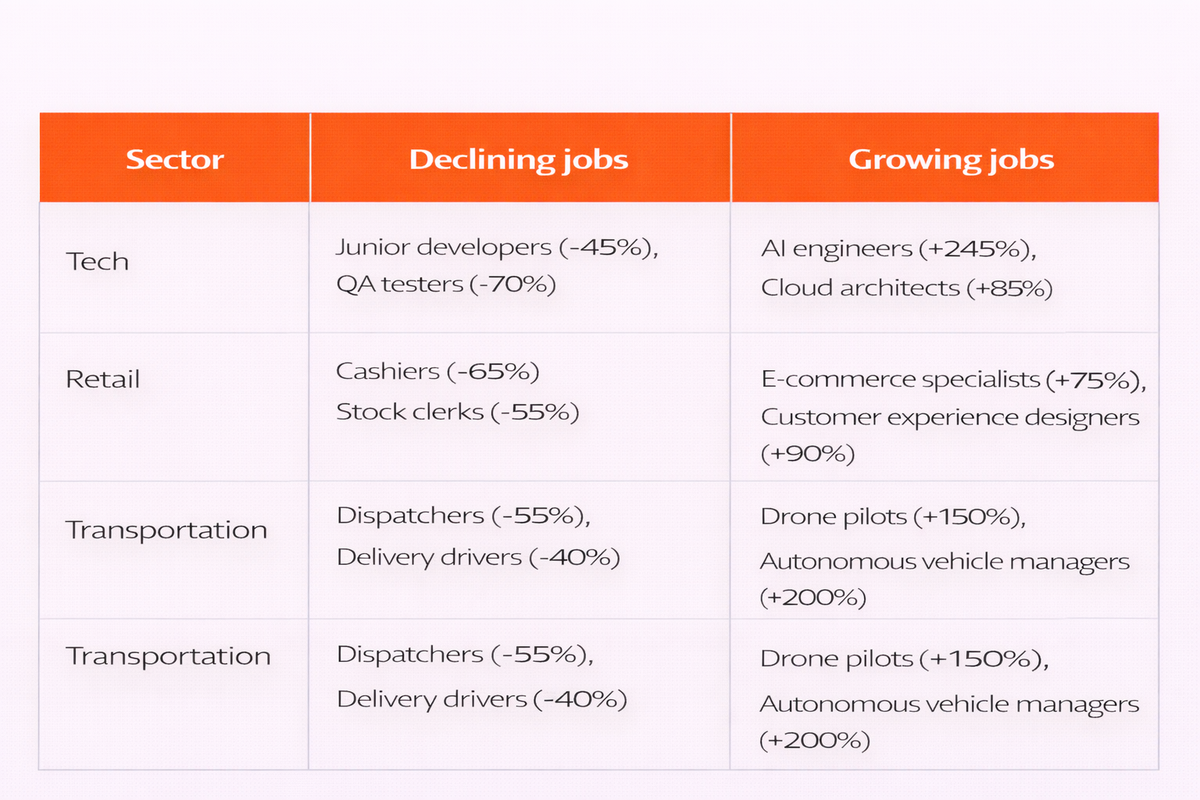
Industry and capability data are proprietary information belonging to Cornerstone; see report for more details.
How can leaders drive workforce changes in 3 steps?
- Use continuous workforce planning to allocate talent and AI effectively
- Identify where AI can replace routine tasks vs where you need human judgment
- Redefine responsibilities and accountability for hybrid teams
Shift 4: Why leaders must develop both technical and human capabilities
Why roles now require both human and technical skills
Every role now requires both technical and human capability. Technical workers need empathy, leadership, and judgment. Human-centered roles need AI literacy, data skills, and digital fluency. In 2026, organizations can only succeed when technical and human capabilities are developed together.
Which skills are increasing the fastest?
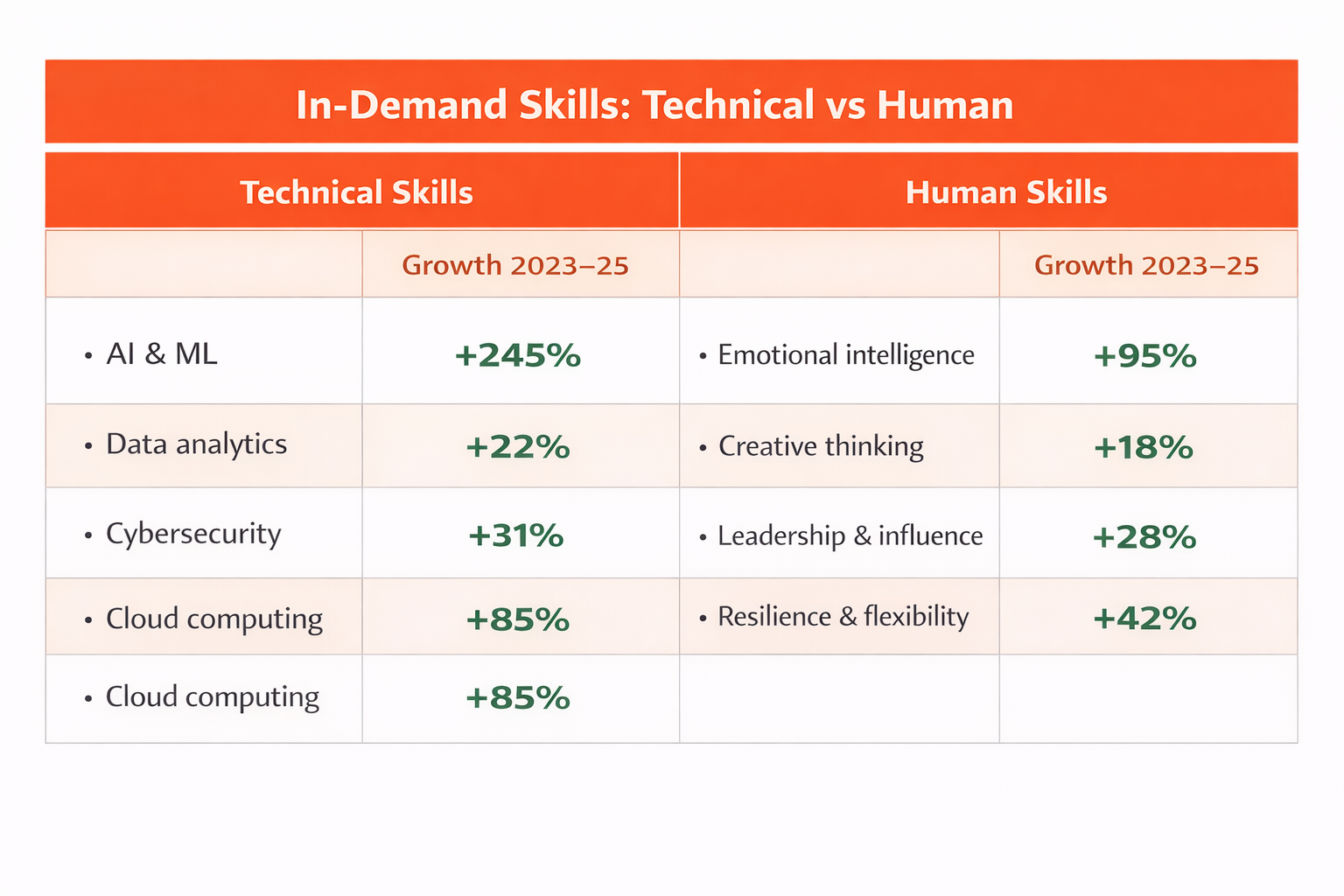
Industry and capability data are proprietary information belonging to Cornerstone; see report for more details.
How can leaders develop strong dual (human + technical) capabilities?
- Integrate human + technical skills development in learning, performance, and leadership programs
- Embed AI literacy across decision-making and strategy discussions
- Redesign talent development to focus on hybrid skill sets
Shift 5: How will “learning in the flow of work” transform L&D in 2026?
Employees learn dynamically through tasks, guided by AI agents that recommend content, skills, and support exactly when needed. Learning becomes embedded in work, not separate from it. Learning in the flow of work makes skill-building continuous and tied directly to performance.
What does this look like in real roles?
- Marketing teams apply AI learning directly into campaign workflows
- Sales reps get micro-learning inside CRM tools during live calls
- AI assigns cross-functional teams based on skills + project needs
How can leaders integrate learning into day-to-day workflows?
- Redesign processes so learning contributes to productivity
- Invest in AI agents that link learning to real performance outcomes
- Measure skill application continuously, not just course completion
What leaders should do now to prepare for the 2026 workforce?
For CEOs:
- Assess skills and capacity gaps with real-time data
- Link AI, workforce, and scenario planning closely
- Identify workforce capabilities needed for strategy pivots
For CHROs:
- Track workforce skills and labor market data
- Collaborate with CIOs to integrate AI into workforce planning
- Redefine tasks and workflows for high-impact roles
For CIOs:
- Map AI vs human judgment responsibilities
- Co-own workforce planning and productivity measurement
- Orchestrate AI and human collaboration for maximum impact
For L&D Leaders:
- Embed AI fluency in all learning programs
- Align learning with business outcomes
- Experiment with joint learning and productivity workflows
For a full guide on workforce transformation, AI integration, and skill-building strategies in 2026, download the Cornerstone 2026 Predictions Report.