Key Takeaways:
- Distinguishing goals and objectives. Goals are long-term achievements while objectives are specific steps to reach those goals.
- There are three types of goals: Time, focus, and topic-based goals are not mutually exclusive and can coexist.
- Use a SMART plan (Specific, Measurable, Actionable, Relevant, Time-bound) for goal achievement, emphasizing accountability and planning.
Editor’s Note:This article was originally published in 2014 and has been comprehensively updated for 2026 to reflect the latest research in behavioral science and organizational productivity.
As the end of the year draws near, I have a tendency to reflect on the goals I've accomplished and start to think about the things I would like to do in the year ahead. But goals are a tricky thing. Set a bad goal and you could end up wasting time and energy. Set a wrong goal and you could end up in a situation you really didn't want. In fact, according to Ohio State University, only 9% of people who set New Year's goals actually complete them.
For instance, let's say I set a goal to learn how to code. There's nothing wrong with coding, right? Correct. But if I'm not looking to become a full-time coder, I might want to make sure that this goal doesn't take up all of my time, preventing me from having goals related to my full-time occupation.
To make sure we set relevant goals, it's important to understand what goals are and how they differ from objectives.
The difference between goals and objectives
- Goals are long-term achievements. They're usually future-focused and don't include actual steps to accomplish the goal. For example, a company might say they have a goal "to be number one in customer satisfaction". That's the goal. But it doesn't outline how the goal will be accomplished.
- Objectives are specific achievements to help you reach the goal. Typically, they're measurable and have a timeline. If we use the goal example above, an objective might be "to improve customer satisfaction scores by 5 points each quarter".
Using my example above of learning how to code, here are an example of a goal and an objective:
- Goal: "I want to learn how to code well enough to attend a hackathon." There's no way I'm going to learn coding overnight, so it's a long-term goal. It's future focused and doesn't have any specific steps on how I plan to achieve the goal.
- Objective: "I'm going to download the Hopscotch app to my iPad and complete one activity a day." This is very specific - download an app and complete one activity a day. (BTW, if you have a secret goal like me to learn a bit about coding, check out the Hopscotch app.)
Knowing the difference between goals and objectives will help you develop achievable goals.
Three types of goals
Now comes the fun part, actually thinking about and establishing your goals. There are three types of goals: based on time, focus and topic.
1. Time goals
Time goals are the ones we refer to as short-term or long-term. An example would be having a short-term goal of learning how to make a roux with a long-term goal of learning how to make gumbo.
2. Focus goals
Focus goals remind me of a BHAG (big hairy audacious goal). It's the one thing that's driving the majority of decisions. For instance, I had a goal last year to write a book. Big goal. It was a huge endeavor and impacted many of my personal and professional decisions.
3. Topic-based goals
Topic-based goals can be personal, professional, career, and financial. Maybe you have a goal to save a certain amount of money. Or to complete a leadership development program. These are goals that are important in a certain aspect of our life.
Time, focus, and topic goals are not mutually exclusive. We can have short-term financial goals, long-term career goals, and a personal BHAG.
Using a SMART plan
After establishing your goals, you have to create a plan to make those goals happen. Think of the plan as creating a series of objectives that will ultimately allow you to accomplish the goal. I'm a big fan of using SMART plans to achieve goals. SMART is an acronym. Here's one of many definitions for the acronym.
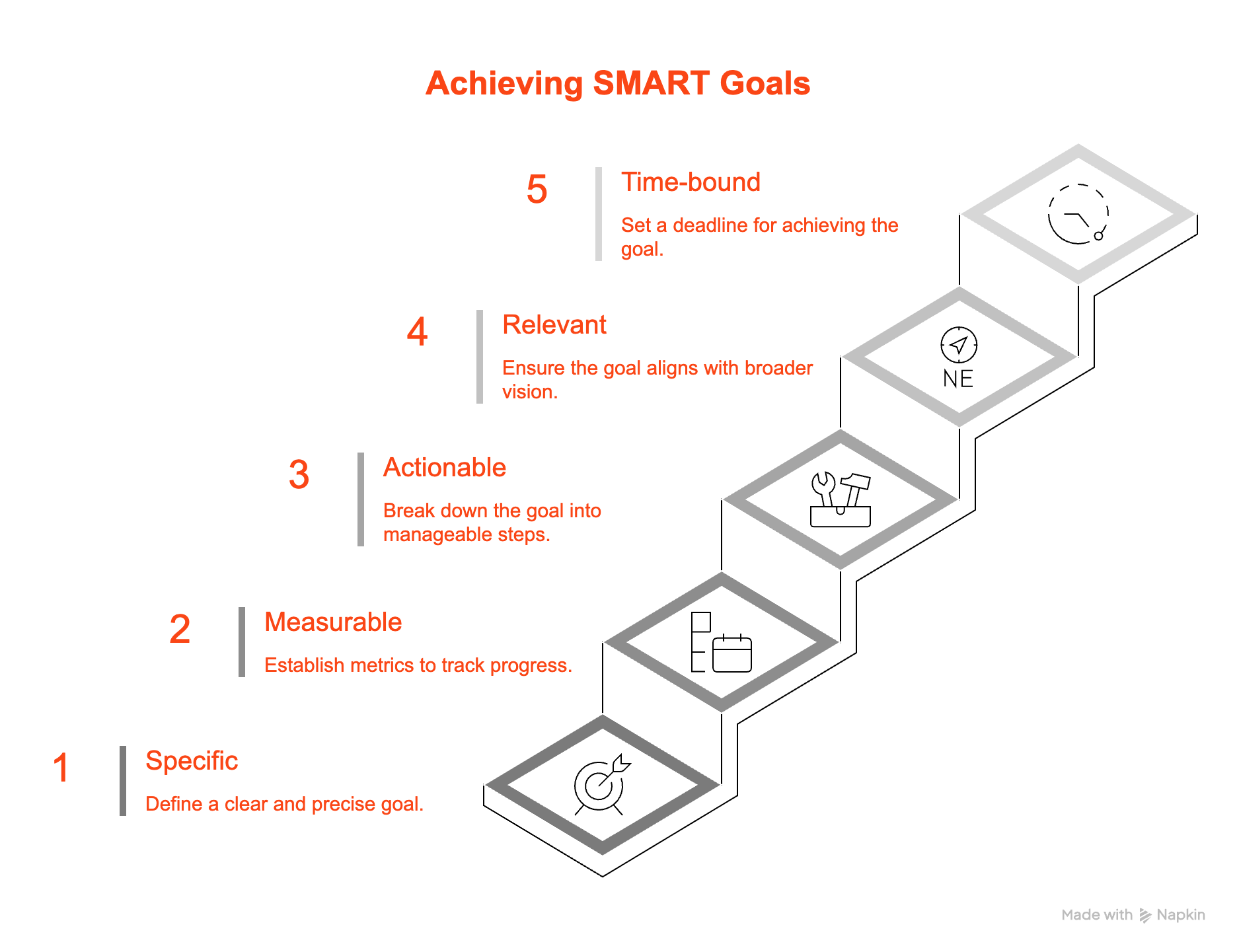
Specific: What is the specific goal you're trying to accomplish? And be specific!
Measurable: How can you measure your success? Think about how you will know when you've accomplished the goal.
Actionable: What are the actionable steps (aka objectives) needed to achieve the goal? Break the goal into smaller steps. List every step.
Relevant: Today, the most critical question is: Is this goal relevant? Does it align with your broader vision? This is a major pain point, as only 32% of employees feel strongly connected to their organization's mission or purpose. If the goal isn't relevant to your "North Star," you're just busy, not productive.
Time-bound: When do you want to achieve this?
Whenever I have a goal, I outline it on a sheet of paper and post it on my office wall. That way it's staring me in the face every day. Having a written plan helps me achieve my goals. And the research supports this best practice! Dr. Gail Matthews from Dominican University found that people who write down their goals are 42% more likely to achieve them than those who don't. Even better, those who send weekly progress updates to a friend have a 76% success rate.
Whether you write down your goal on a sheet of paper or track it online, the important part is setting the goal, creating the plan, and holding yourself accountable.
Goal setting and business success
Goal setting is a frequently used term in business. That's because it's an important part of business success. We can't move forward without goals.
Small goals lead to big accomplishments. Short-term goals create long-term achievements. Professional goals can help us realize our personal goals.
So, what are your goals for this year? It's time to make things happen.
Get in touch with one of our experts to explore how we can tailor our solutions to your organization's needs.