Key Takeaways
- AI literacy is mandatory—for all staff handling AI systems—by February 2, 2025.
- Recruitment and performance-monitoring AI systems are deemed high-risk—strict transparency, oversight required.
- Emotion-recognition AI in workplaces is prohibited, except for medical or safety purposes.
Here at Cornerstone, we welcome the EU AI Act as validation of the Cornerstone Transform (formerly known as Skyhive) commitment to responsible and ethical AI.
In this article, we discuss the EU AI Act and its relevance for AI-powered skills-based intelligence.
The EU AI Act may also influence regulation in other regions, including the AI Safety Institute Consortium in the United States and the Guide on AI Governance and Ethics by the Association of Southeast Asian Nations (ASEAN).
About the EU AI Act
The EU AI Act definition of AI mirrors the OECD AI definition. AI systems operate with some level of autonomy and infer from inputs how to generate content, predictions, and recommendations that influence virtual or physical environments.
The AI Act builds upon the EU’s previous GDPR mandates for data privacy.
The Act applies to organizations and individuals in the European Union who deploy or import AI systems. Excluded are AI systems developed or used exclusively for military purposes.
Despite a length of several hundred pages, there are some aspects of the Act that remain unclear. “There is little clarity and precision regarding [how the EU AI Act covers] distributors”, notes law firm WilmerHale.
The EU AI Act provides for EU-wide rules on data quality, transparency, human oversight, and accountability. Fines for noncompliance range up to 35 million Euros or 7% of global annual revenue, whichever is higher.
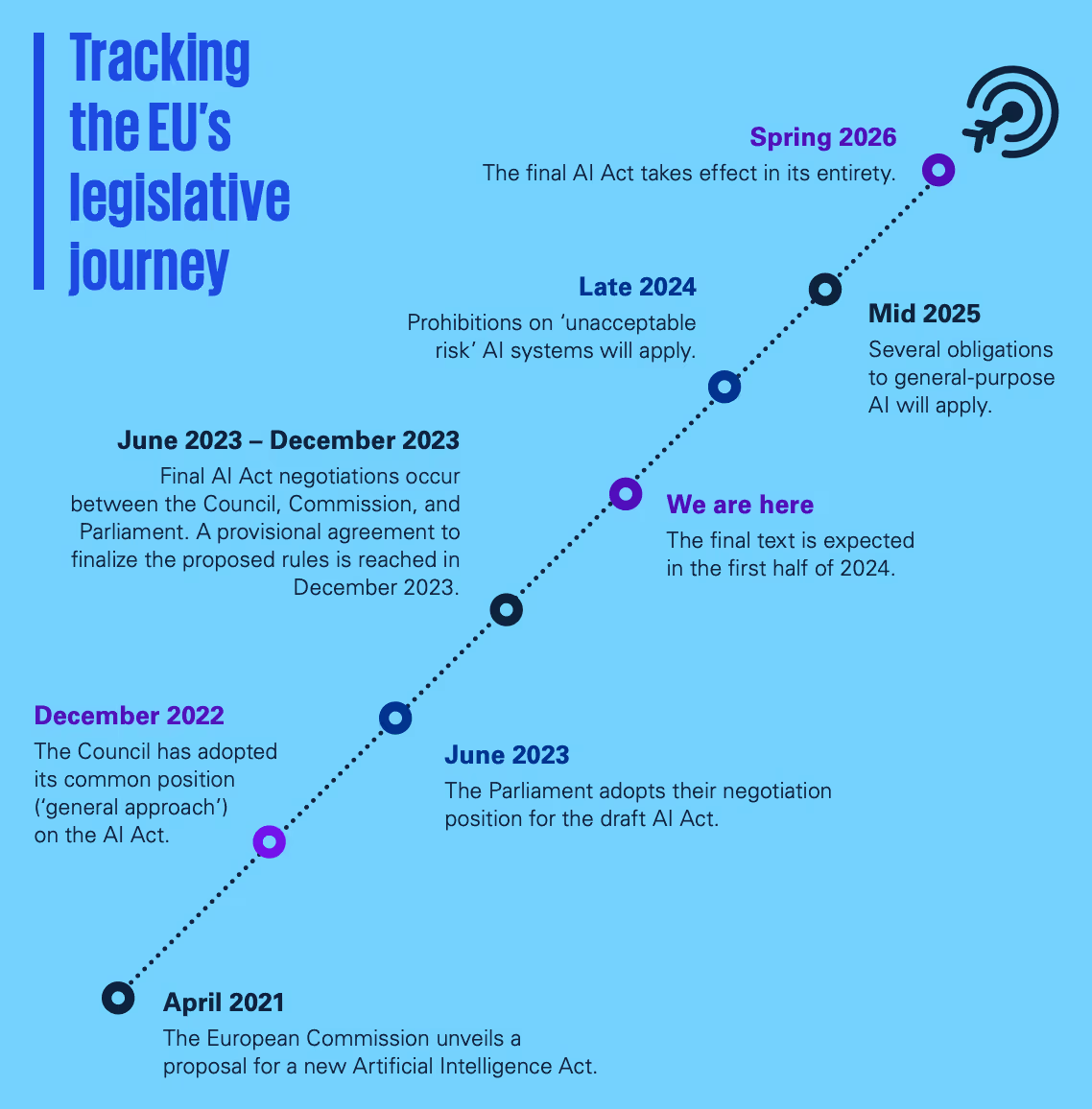
The European Parliament adopted the AI Act on March 13, 2024. The Act enters into force 20 days after publication in the Official Journal (https://eur-lex.europa.eu/homepage.html). What comes next is a phased implementation between late 2024 and mid 2026. Bans on prohibited AI systems start in six months. Obligations for general-purpose AI such as GenAI large language models (LLMs) start in mid 2025.
KPMG provides a helpful chronology in “Decoding the EU AI Act”.
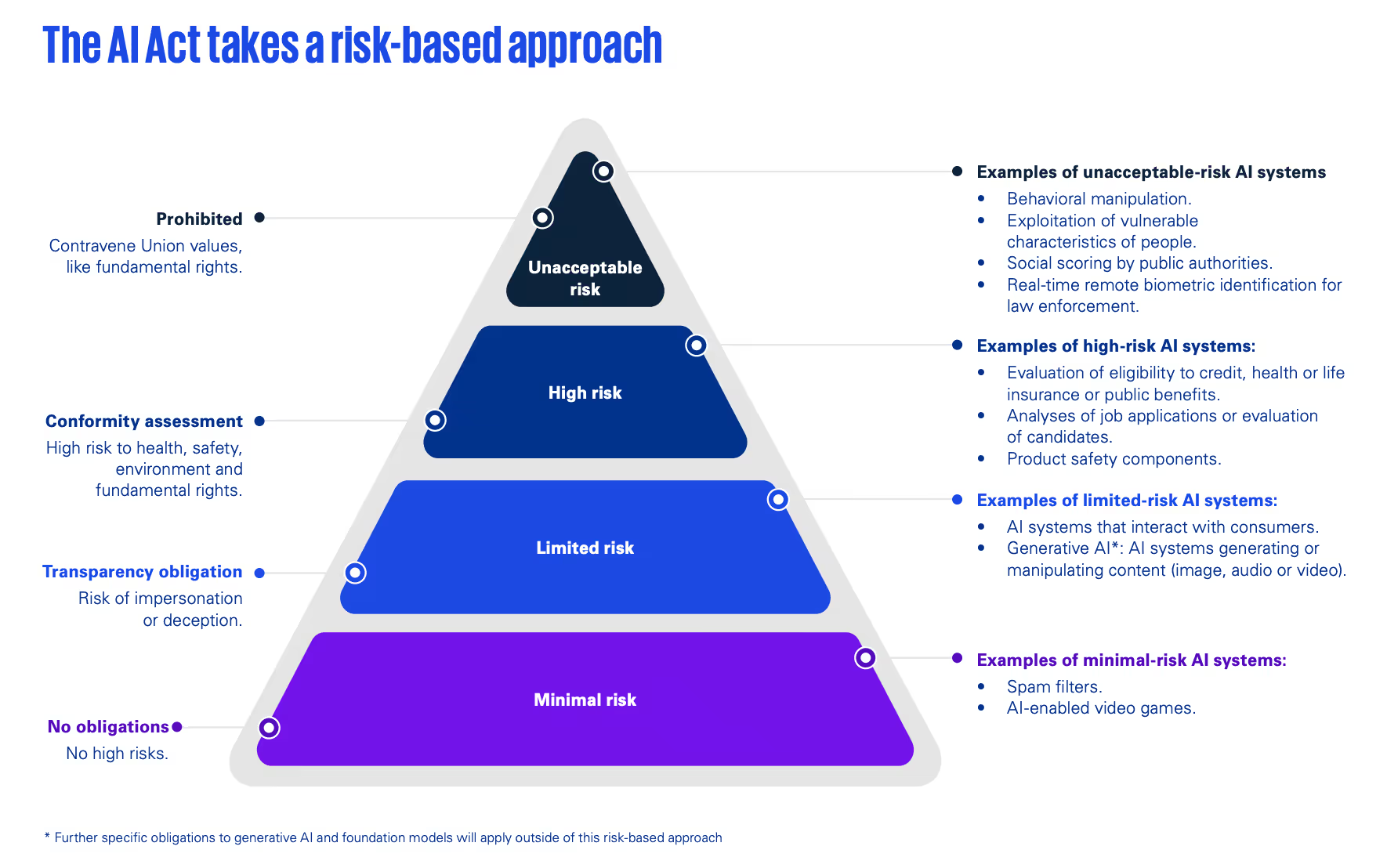
The EU AI Act establishes a four-part range of risk: unacceptable, high, limited, and minimal risks.
- Unacceptable risks include social scoring by public authorities. Unlike skills-based intelligence, which helps match people with relevant skills to available jobs, this prohibition applies to profiling or discrimination by social behavior.
- High risk AI systems are permitted but must meet the most stringent requirements. The EU AI Act includes analysis of job applications and evaluation of job candidates as high risk.
- Limited risk covers use of general purpose AI such as GenAI models that facilitate natural language questions of skills-intelligence data.
- Minimal risk includes email spam filters and video games. “What qualifies as low-risk remains unclear” per Mercer.
Compliance with the EU AI Act
The Act’s provisions require that AI systems minimize bias that can result in unfair or inadequate outcomes. This is near and dear to Cornerstone.
We view compliance with the EU AI Act and GDPR as integral to our longstanding commitment to responsible and ethical AI.
SkyHive (now a part of Cornerstone) Skill Models are Armilla Verified as free of AI bias and meet the demanding standards set by the EU AI Act, New York City’s Local Law 144, and future regulations.
SkyHive (now a part of Cornerstone) ethical AI has been vetted or audited by over 100 large enterprise and government customers. SkyHive (now a part of Cornerstone) Co-Founder and CTO Mohan Reddy serves as an expert advisor for the Responsible AI Institute.
Our data collection, processing, and privacy protections follow six principles to ethical and responsible AI: transparency, explainability, robustness, trust, confidentiality, and accountability.
Powering the Transition from Jobs to Skills
As the leader in AI-powered skills intelligence, Cornerstone supports organizations and communities to hire, manage & retain people with in-demand skills and to upskill and reskill your workforce.
Cornerstone is transitioning the European fishing and aquaculture sector with financial backing from the European Institute of Innovation and Technology, a body of the European Union.
Cornerstone profiles go beyond resumes, CVs, and LinkedIn profiles to include education, hobbies, and credentials.
When people self-report on their skills, they impose limitations. They don’t fully realize how skilled they are. On average, individuals identify 11 skills for their particular role. Using Cornerstone, that number jumps to an average of 34.
Identifying a wider range of skills, and adjacent skills available to learn, has important benefits for professional development, performance management, learning and development.
In awarding SkyHive (now a part of Cornerstone) one of the “Next Big Technologies Working for Social Good in 2023”, Fast Company explains that the HR and workforce intelligence platform “uses AI to match people to jobs they might not have thought were a fit but that they actually have the transferable skills for…. and it even shows learning opportunities that could help bridge a skill gap to enter a new career.”
Explainable AI
Mercer advises to “Avoid building and using high-risk tech solutions, such as ‘black-box’ AI tools that automate HR processes with little documentation and transparency. There is a risk that these may be banned or difficult to implement, given the EU AI Act.”
In contrast to “black-box” AI tools, HR Skills intelligence platform adopts explainable AI and human-in-the-loop approaches, so that humans can understand and interpret the model outputs.
The tool's Labor Market Intelligence (LMI) provides global data on job vacancies and in-demand skills in real time. SkyHive ingests an average of 28TB or more of raw data a day across 200 countries and territories.
The tool combines skill extraction and inference with LMI-based recommendations. We produce the market’s largest knowledge graph of human capital data. This includes over 5 billion job descriptions and 1 billion anonymized job profiles.
The HR and workforce intelligence platform never uses customer data to train our models. We gather public-domain data on the labor market and in-demand skills from job boards, resumes, course outlines, census data, corporate annual reports, and government labor market statistics.
The LMI looks at patent applications and academic journals to derive new skills that are becoming in demand.