Key takeaways
- A structured, data-driven skills gap assessment enables leaders to align workforce capabilities with business goals and future demands.
- AI-powered skills intelligence provides real-time visibility, automates skills mapping, and drives smarter, data-backed talent and learning decisions.
- Effective skills gap assessments transform workforce insights into a strategic advantage, driving growth, adaptability, and long-term talent retention.
Lack of visibility into your workforce’s capabilities can pose a risk to your business operations. A skills gap assessment is the strategic process of identifying the disparity between the skills your organization needs and your people's current skills by comparing current employee skills to the skills required for business success. Understanding your workforce's current capabilities is essential to mitigate business risk and ensure your organization is prepared for future demands.
A skills gap analysis helps organizations pinpoint workforce skill deficiencies, guide targeted training initiatives, and inform hiring decisions to maintain organizational agility.
According to the World Economic Forum's Future of Jobs Report 2025, 63% of organizations now cite the skills gap as the primary barrier to transformation, a challenge that outranks nearly all other business risks. Ignoring unaddressed skills gaps in your workforce means sacrificing the agility, innovation, and growth your business needs to stay ahead.
What is a skills gap analysis and why every organization needs one
A skills gap analysis is a structured process for identifying gaps, measuring their severity, and prioritizing the difference between the skills your people have and the skills your organization needs. These gaps can be technical, like missing proficiency in data analytics, or behavioral, like a lack of change management capabilities. When skills gaps go unidentified, they quietly erode productivity, slow transformation efforts, and limit growth.
A skills gap analysis connects workforce data to business strategy, informing where to invest in training, where to hire, and where to redeploy talent. A thorough skill gap assessment gives you the clarity to act with confidence instead of guessing where your workforce stands. It give leaders a data-driven foundation to guide training investments, hiring decisions, and workforce planning. When done well, a skills gap analysis turns workforce visibility from a gap you cannot see into a strategic advantage.
Skills gap analysis example
Case study: How a leading healthtech company closed its skills gap
Real-world organizations are already implementing strategic skills gap assessments with measurable results. A leader in healthcare cloud technology faced a critical challenge that mirrors what many organizations encounter today. As their Principal of Talent and Development explained: "We really need to be able to staff positions quickly as we flex up and down. If we're working on a project for a state or client and that comes to an end, we need to be ready for the next one. Plus, we have a lot of priority roles, and with the right skills always in short supply, we can't always fill them from the outside."
Their methodology exemplifies the strategic thinking required for effective skills assessment. Rather than simply conducting a traditional inventory, the organization launched its skills transformation initiative with a clear methodology. "The first, fundamental step was understanding what skills the employees had, not just what was listed on their current job description, but everything they had learned in their careers that might be useful and could be translated into the language of skills." Cataloging existing skills gave the organization accurate data on where gaps exist and what future workforce planning requires.
The results from the Cornerstone Skills platform show the power of AI-driven assessment. "The people discovered a broader range of skills, some of which they might not even have been aware they had. The number 22 is significant. Across the job market, people list an average of 11 skills when asked about their skillset. However, using a skills-based HR and talent intelligence platform, the employees discovered a broader range of skills," showing how modern technology can reveal hidden capabilities that traditional assessments miss.
The organizational impact of the Cornerstone platform validates the strategic importance of a skills gap assessment. "By the end of 2022, 83 percent of people had a skills profile," and the results were immediate. As their talent leader noted, "the organization can finally move rapidly and with flexibility because we now know what our workforce is capable of accomplishing."
The high cost of invisibility: Why a skills gap assessment is so essential
Operating without a clear understanding of your workforce's skills leads to misaligned training investments, flawed strategic decisions, and an inability to adapt when it matters most. Skill assessments and collecting relevant data are essential for identifying training needs and ensuring that development efforts are targeted and effective. The World Economic Forum report estimates that by 2030, nearly six out of every ten workers will require significant training just to meet the evolving demands of their roles.
The cost of inaction can be tangibly felt in a business. It manifests as decreased productivity, prolonged project timelines, failed strategic initiatives, and the high expense of recruiting externally for capabilities that could have been built from within. A skills gap analysis helps organizations improve overall performance and employee performance by identifying areas for targeted development. This will provide you with the data-driven foundation to move from a reactive to a proactive talent strategy, turning your people into your most powerful competitive advantage.
The disconnect between credentials and capability is striking across industries. For example, “Only 43 percent of employees in a so-called STEM field have STEM degrees," according to research conducted by the Commerce Department. This statistic reveals that the most critical skills for business success often exist outside traditional educational pathways, making a comprehensive skills assessment essential for identifying hidden talent.
As Cornerstone expert Cyril Le Mat put it, a skills gap assessment is about more than ticking an administrative box, rather, “It’s about not guessing the skills organizations have in place, or to say which ones are the most strategic, but to allow organizations to understand the skills their employees have, to expand these skills through suggestions, and to put them to good use.”
A skills gap analysis shows where training plans should be focused for maximum impact, ensuring that workforce development aligns with business priorities.
The 5-step framework for a data-driven skills gap assessment
To conduct a successful skills gap analysis, you'll need a structured and repeatable framework that is integrated with strategic workforce planning to ensure your organization meets future needs and aligns with overall business priorities. You may have seen frameworks with four steps: plan, identify, measure, and act. The fifth step here, building for the future, closes the loop between a one-time audit and an ongoing strategic capability.
Step 1: Start with your strategic business goals
The most effective skills gap assessments begin with understanding the broader workforce readiness challenges. As we discovered in the Cornerstone workforce readiness research, "The workforce readiness gap is the disparity between what employers need and what job seekers offer. But this contrast is also a call to action, urging us to rethink professional development and the essence of adaptability in a world that shifts with every technological leap."
A strategic perspective ensures that skills assessments address not just current gaps, but future organizational needs.
Start by looking at your business strategy. Before assessing anything, answer the foundational question: "What are we trying to achieve in the next 1 - 3 years?". Whether you are launching a new product, expanding into a new market, or driving a digital transformation, your company's goals and business priorities are the only lens that matters. Aligning your assessment with future workforce needs and skills ensures your organization can achieve business goals and meet future demands. This will also ensure your assessment is focused on identifying the specific capabilities, desired skills, and desired skill levels you’ll need for future success, rather than just inventorying the skills you have today.
Step 2: Map the skills you need to win
With clear goals, you can translate them into specific skill requirements. For each key objective, identify the critical roles and the precise skills needed to succeed. According to the World Economic Forum's Future of Jobs Report 2025, the most critical skills are a sophisticated blend of cognitive, interpersonal, and technological abilities:
- Cognitive skills: Analytical thinking remains the single most vital skill for employers.
- Self-efficacy: Resilience, flexibility, and agility are non-negotiable for navigating change.
- Technology skills: Foundational technological literacy is now a top ten core competency, while skills in AI and big data are rapidly growing in importance.
When mapping skills, knowledge, and competencies within your organization, it helps to have a working definition of each of these elements (visualized below).
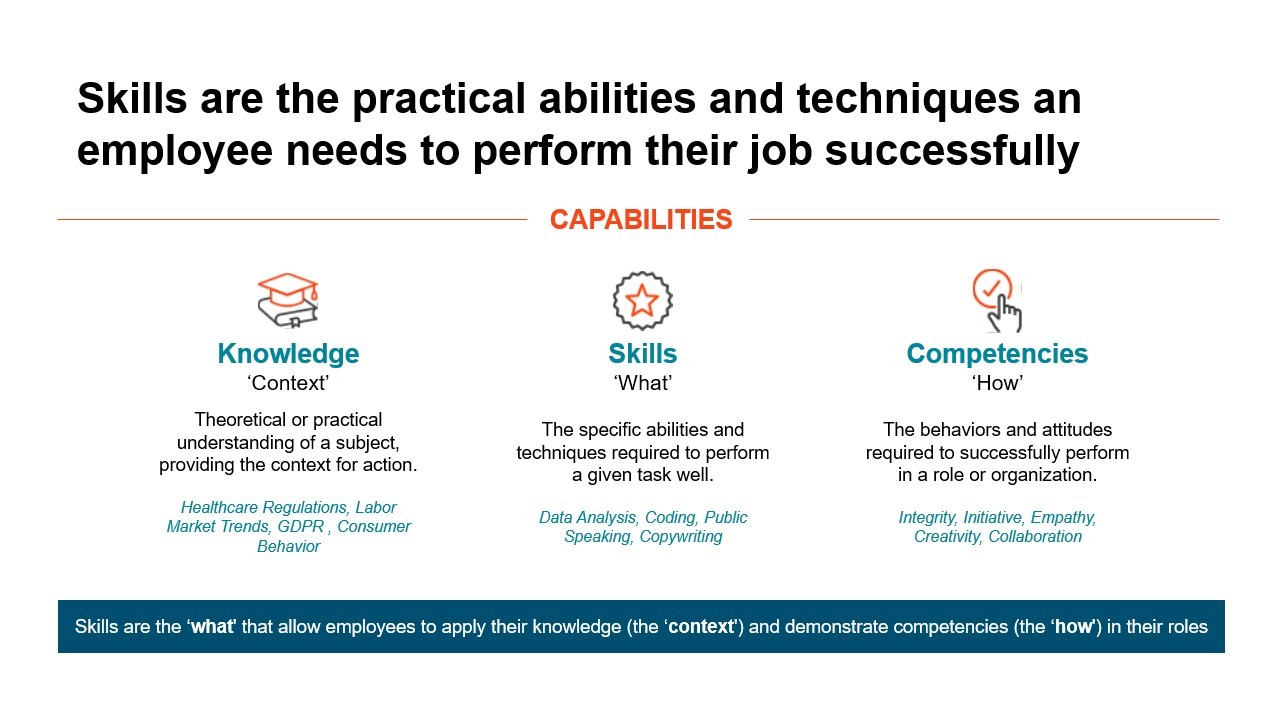
Organizations must focus on skills critical for success, addressing both technical (hard skills) and interpersonal (soft skills) capabilities. In the age of AI, it's equally important to define the skill sets and training needed to prepare your workforce with the right AI competencies to meet business goals.
Step 3: Assess your current workforce skills
Step 3 is the data collection phase. While traditional methods like manager evaluations and self-assessments provide a starting point, they are often subjective and can quickly become outdated.
Skills transformation leaders have discovered that traditional evaluation methods fail to predict success. Google's transformation exemplifies this shift: "company recruiters used to ask candidates for transcripts, GPAs, and test scores before concluding they were 'worthless' for hiring purposes," according to Laszlo Bock, senior vice president of people operations at Google. Today, Google evaluates candidates using behavioral interviewing, where past behavior and actual skills are valued above credentials.
The real breakthrough comes from using AI-powered skills inference, which can analyze data from across the business, such as project histories, performance reviews, and learning data, to build an objective, dynamic, and comprehensive skills profile for every person in the company.
Step 4: Analyze the gaps and prioritize for impact
Once you have data on both your current and required skills, you can begin to perform the analysis. The "gap" is the distance between these two profiles. This analysis should happen at the individual, team, and organizational levels, often visualized in a skills matrix or heat map that clearly shows where your most critical gaps lie. Prioritization is key. Focus on the gaps that pose the most significant risk to achieving the strategic goals you defined in Step 1.
Step 5: Take action and build for the future
An assessment is useless without action. The final step is to create a data-driven action plan to close your prioritized gaps. The Future of Jobs Report 2025 confirms that global leaders are focused on a blend of strategies, with upskilling the current workforce being the top priority for 85% of employers. Your plan should be integrated with your Learning Management System (LMS) and should include:
- Reskilling: Training your people for new roles.
- Upskilling: Deepening a person’s skills for their current role.
- Hiring: Strategically recruiting for skills that are too costly or time-consuming to build internally.
- Mobility: Deploying people with the right skills to the projects where they are needed most and can make the greatest impact.
The technology advantage: Transforming a static report into a strategic engine
Traditional assessment methods often fall short. Our experts noted in an article on using AI and skills intelligence that "With AI-powered skills intelligence, HR professionals have the upper hand in redefining talent management and unleashing the untapped potential of their workforce. This revolutionary shift allows for strategic decision-making based on insights derived from comprehensive data analysis."
Modern AI-powered platforms can analyze vast amounts of data to provide predictive analytics and real-time feedback, ensuring employees receive the right development opportunities to enhance their skills and drive organizational growth.
The WEF's 2025 report makes it clear that AI’s greatest impact will be augmentation, not just automation. While AI can substitute certain tasks, it has a "very low capacity" to replace human-centric skills like leadership, empathy, and creative problem-solving. This new reality demands a platform that provides visibility into the full spectrum of your workforce's capabilities.
AI-powered talent and learning management platforms can:
- Automate skill inference: Objectively identify people’s skills based on their work and learning history.
- Provide real-time visibility: Offer your leaders an always-on view of the skills landscape.
- Connect skills to content: Intelligently recommend personalized training to close any individual skill gaps.
- Power a talent marketplace: Match your people’s skills and aspirations to internal projects and roles, which both drive internal mobility and retention.
In our guide on addressing the skills gap, the experts at Cornerstone highlight the fact that "AI-powered tools not only handle mundane inquiries but also provide personalized support, allowing HR professionals to devote their time and energy to strategic initiatives that foster growth while gaining valuable insights into skills data that can inform talent development and drive overall productivity." This technology enables organizations to move beyond traditional, static assessments to dynamic, continuous skills intelligence.
Skills gap analysis tools: What to look for
When evaluating skills gap analysis tools, organizations typically assess three categories:
- Data & assessment: how skills are captured, validated, and scored
- Gap identification and benchmarking: how gaps are detected vs. targets/roles/levels
- Actionability and planning: can give you learning recommendations, roadmaps, tracking (and even allow you to create agents that can do all that)
When looking for an AI-native skills intelligence platforms, a powerful tool will infer and map skills dynamically across your workforce by analyzing work history, learning activity, and performance data. Look for platforms that connect skills data directly to learning recommendations, internal mobility, and workforce planning rather than just producing static skill labels. Learning management systems with built-in skills tracking tie development activity to specific skill outcomes, creating a closed loop between training and capability growth. Having dedicated skills assessment software will help measure proficiency through structured evaluations and certifications, which is useful for compliance-driven industries or technical roles.
The most effective tool to conducting a skills gap analysis or competency gap analysis combines all of these software features into a single, governed ecosystem. The Cornerstone Workforce AI platform connects live skills intelligence to learning, mobility, and talent decisions in one platform, giving you a continuously updated view of where your workforce stands and where it needs to go.
By leveraging technology like the Cornerstone Skills Optimization platform, the skills gap analysis evolves from a static report into a dynamic engine for continuous growth within your organization.
Governance: Sustaining momentum and ownership
For skills initiatives to scale and endure, governance must be intentional. This means defining who owns the process, who interprets the data, and who is responsible for turning insights into action.
Strategic skills planning requires organizational alignment. In the Cornerstone guide on addressing the workforce skills gap, we note that "Leaders should meet to share their predictions about the skills that their company will need over the next two to five years, consider how those skills will support business growth, and create a plan that will align talent management, training, and culture to help achieve those goals." By looking beyond the resume and hiring with forward-looking skills in mind, organizations can build a future-proofed employee base.
A successful governance model brings together cross-functional stakeholders: HR and L&D provide expertise and infrastructure. Business leaders set direction based on goals, and IT ensures the systems that support data flow and privacy. Without this collaboration, even the most sophisticated assessments risk being ignored.
Your governance framework must also maintain data hygiene and integrity over time. Skills data must be continuously updated, validated, and protected, especially in large, distributed organizations. When your governance framework defines data ownership and review cycles, skills data stays consistent, accountable, and ethically governed across every learning and talent decision.
Embracing continuous assessment
A one-off skills assessment is no longer sufficient. As business needs evolve and people grow in their roles, yesterday’s data quickly becomes outdated. Regularly performing skills gap analysis is essential to identify knowledge and skill deficiencies, or skills vs competencies, thus ensuring your workforce keeps pace with changing requirements. Consider conducting a skills assessment after major change management occurs and potentially every 6 months if industry trends and technology are evolving quickly.
A modern approach treats skills assessment as a continuous process. With the right technology in place, organizations can keep skills profiles refreshed in real time, capturing learning activity, project involvement, certifications, and peer reviews automatically.
Leaders can respond with agility when skills profiles update automatically, whether forming a new team for an urgent project or identifying emerging skills trends across departments. Real-time visibility empowers smarter, faster decisions and keeps upskilling efforts aligned with current organizational needs, not assumptions from six months ago.
Continuous assessment transforms skills intelligence from a static report into a strategic asset that evolves with your people and your priorities. It also inspires a culture of continuous learning and improvement in your organization.
Frequently asked questions
What is the difference between a skills gap and a competency gap?
A skills gap refers to missing specific, task-oriented abilities that are transferable across different contexts, while a competency gap is broader and encompasses missing skills, knowledge, behaviors, and attitudes necessary for effective performance in a specific role. For example, a skills gap might be lacking Excel proficiency, whereas a competency gap could be missing the entire financial analysis competency (which includes Excel skills, financial knowledge, analytical thinking, and attention to detail). Skills gaps are more agile to address and can help organizations pivot quickly.
How often should a skills gap assessment be conducted?
Annually is no longer enough. The pace of change today requires an ongoing approach. AI-powered technology allows for an "always-on" assessment where skills data is constantly refreshed, providing real-time insights for agile decision-making.
Can a skills gap assessment help with employee retention?
Absolutely. When people see that their company is invested in understanding their skills and providing clear paths for growth, their engagement and loyalty increase. A skills gap assessment is the first step in creating meaningful career pathing and internal mobility opportunities that serve as a powerful driver of retention. The Future of Jobs Report 2025 validates this, showing that a majority of employers see a direct link between training investment and retaining their best people.
Ready to identify the gaps in your workforce? Book a demo to see how Cornerstone Workforce AI can help you turn skills intelligence into a strategic advantage.


